




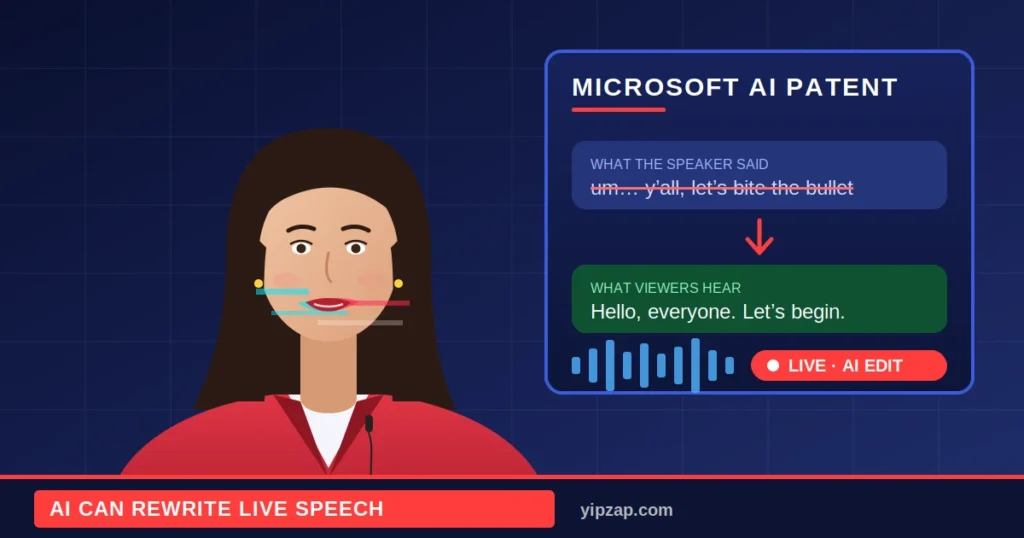
The Microsoft AI patent making headlines today describes a system that can change what a speaker says on live video, in near real time, and then reshape the speaker’s face and mouth so the new words look natural. Microsoft filed the application under the title near real-time AI enhancement of video or AR presentations of live events. In plain terms, the technology could let a viewer watch a live broadcast where the words on screen are not exactly the words the speaker said.
Key Takeaways
- The filing describes AI agents that remove or replace words in live video and audio, then edit the speaker’s lips and face to match.
- Planned uses include live translation, removing filler words like “um” and “ah,” and smoothing out stutters.
- The same system could also swap out slang, mistakes, and words judged offensive or inappropriate.
- Microsoft has not announced any product, and a patent filing does not mean the technology will launch.
What the Microsoft AI Patent Describes
The document is published as US 2026/0341309 A1. The “A1” label marks it as a published patent application, which means the filing is still a request for protection and not a granted patent. Even so, the details inside the application show how Microsoft is thinking about the future of AI video editing.
According to the filing, a group of AI agents would watch a live event as it happens. Those agents would spot specific words, then change or delete them. After that, the system would edit the speaker’s mouth and face so the video still looks believable. It would also blend the video and audio just before and after each edit, so the viewer never notices a jump or a glitch.
How the Real-Time AI Video System Would Work
The system would not make random changes. The agents would follow fixed rules or a personal viewer profile, which means two people could watch the same live event and see two different versions. One viewer might get a cleaned-up speech with no filler words. Another might get the same speech translated into a different language, with the speaker’s lips moving to match.
The patent also says the technology could pull replacement words from an internet search. That detail matters because it suggests the AI would not only delete language but also choose new language to take its place.
Possible Uses: Live Translation, Filler Words and Speech Fixes
Some of the uses in the filing sound helpful. Real-time AI translation could let people follow a foreign-language broadcast and see the speaker appear to talk in their own language. The system could also strip out “um” and “ah,” and it could remove stutters or the effects of a speech impediment.
Other examples go much further. The filing lists personal phrases, coined terms, and regional expressions such as “y’all” or “bite the bullet” as words the system could trim. It also names mumbled, mispronounced, misused, misspoken, offensive, insensitive, and inappropriate words as targets. That list turns a simple clean-up tool into something that decides which speech is acceptable.
Which Live Events Could Use This Technology
Microsoft’s filing points to many kinds of live content. These include lectures and presentations, television productions such as award shows, game shows, and cooking shows, and live sports. Because the system works while an event is still unfolding, it targets the exact moment when a broadcast is supposed to be unedited.
| Company | Microsoft |
|---|---|
| Filing | US 2026/0341309 A1 (published patent application) |
| Core idea | Near real-time AI edits to words, faces, and mouths in live video |
| Main uses named | Translation, filler-word removal, speech fixes, language filtering |
| Safeguard mentioned | Original live audio and video can be saved as “ground truth” |
| Product status | No launch announced |
Deepfake and Misinformation Concerns
This Microsoft AI patent arrives at a time when deepfakes and AI-generated misinformation already worry governments, newsrooms, and ordinary users. A tool that rewrites live speech could blur the line between a real statement and an edited one, and it could do so on a personal level for each viewer.
That shift raises a hard question about filter bubbles. If people can erase accents, dialect words, or opinions they dislike, they may drift further into a personalized version of reality. Critics also point out that anyone with access to such a tool could, in theory, put words in a public figure’s mouth during a live event.
The filing does include one safety idea. It says the system may record and store the original video and audio as “ground truth,” so a record of what the speaker truly said would still exist. The patent does not explain who would control that record or whether viewers could see it.
Will Microsoft Launch This Real-Time AI Video Tool?
Nothing so far suggests a launch. Companies file large numbers of patents to protect ideas, and many never become products. Microsoft had not responded to requests for comment when the story first surfaced. Still, the company has explored related speech technology before, including an earlier filing for an automatic dubbing system that replaces voices in films and games with synthetic ones in other languages.
Final Take: Why This AI Patent Matters
The Microsoft AI patent does not prove that live video will soon be rewritten behind the scenes. It does show where big tech companies are looking as AI video, voice cloning, and real-time translation improve. The benefits, such as better accessibility and instant translation, are real. The risks, including manipulated live footage and lost trust in what we see and hear, are just as real. As this technology moves from patent pages toward possible products, clear labels and strong safeguards will decide whether it helps audiences or misleads them.
Readmore : How Simple “Thank You” and “Please” Cost OpenAI Millions of Dollars Every Year
click here : Lovable Opens London Office