






A Malaysia minister overwork turns you gay claim has triggered a wave of criticism after the country’s religious affairs official suggested that excessive workplace stress could push individuals toward what he called an LGBTQ lifestyle. The remarks, delivered by Dr Zulkifli Hasan, minister in the Prime Minister’s Department overseeing religious affairs, have drawn condemnation from human rights organizations, opposition voices and ordinary citizens across Malaysia and beyond.
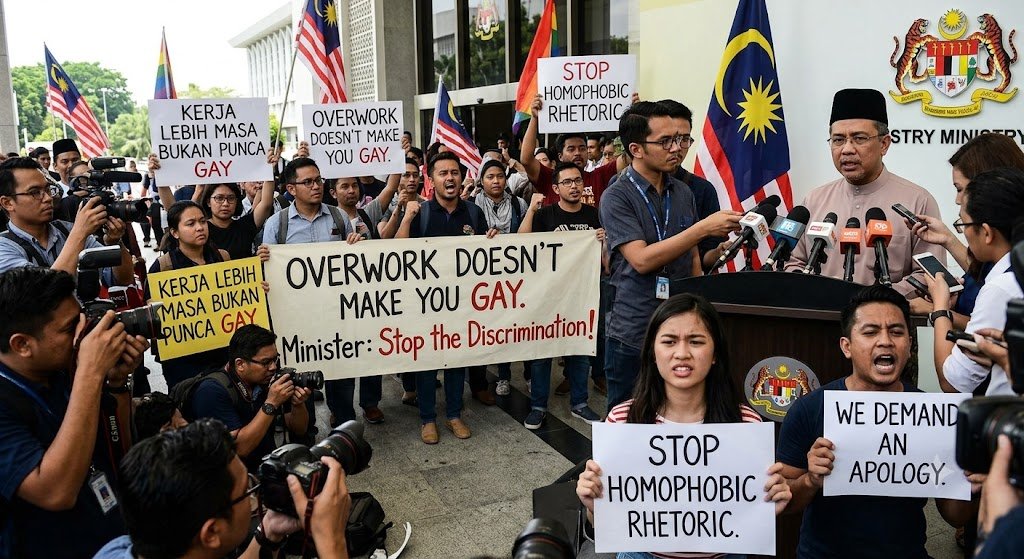
What The Minister Said
Zulkifli made the comments while responding to a parliamentary question submitted by an opposition lawmaker from an Islamist party who had requested data on LGBTQ trends in the country. In his written reply, the minister pointed to four supposed contributing factors behind LGBTQ identity: heavy work-related stress, social pressure, sexual experiences and a lack of religious devotion. He argued that when a person becomes physically and mentally drained from overwork, that exhaustion can cloud judgment and potentially alter their sexual orientation. He tied his reasoning back to a study published nearly a decade ago and insisted that stronger adherence to religious teachings would prevent such outcomes altogether. He also noted that comprehensive data on the number of LGBTQ people in Malaysia remains limited, which he used to frame the scale of the issue as uncertain even as he described its supposed causes.
Public And Political Backlash
The response spread quickly once it reached the public, and reaction was swift and largely mocking. Social media users across Malaysia flooded platforms with jokes suggesting the entire country should take a day off work to avoid mass conversion, a line that turned into a widely shared meme within hours. One widely circulated joke asked whether the minister himself must not be working hard enough, given his own orientation. Others pointed out the irony of a government official using a single old study to make sweeping claims about an entire community. The mockery crossed borders too, with commentators in neighboring Thailand dismissing the theory as scientifically unrealistic and pointing out that workload has no bearing on a person’s identity.
Beyond the jokes, the backlash carried a serious edge. Rights advocates and LGBTQ organizations blasted the minister’s framing as unscientific, reductive and dehumanizing. Critics argued that tying sexual orientation to burnout or spiritual shortcomings strips away decades of medical consensus establishing that sexual orientation and gender identity are natural variations of human diversity, not conditions triggered by fatigue or lifestyle choices. Several advocacy voices called on the minister to formally retract his statement and correct what they described as dangerous misinformation being spread from an official government platform. Some commentators also noted the irony of an ethnic community being stereotyped through the same kind of broad generalization the minister applied to LGBTQ individuals.
Minister Responds To Criticism
Facing mounting pressure, Zulkifli issued a follow-up statement claiming his original remarks had been misread and taken out of context. He urged the public and fellow lawmakers to review his full written parliamentary response rather than relying on shortened summaries circulating online. At the same time, he reaffirmed his department’s firm opposition to normalizing LGBTQ identity, describing it as incompatible with religious teaching, morality and the country’s broader social values.
Why This Story Matters
The controversy lands amid heightened scrutiny of LGBTQ communities in Malaysia, a Muslim-majority nation where same-sex relations remain criminalized under colonial-era law. Just weeks before the minister’s comments, authorities had already cracked down on a private retreat accused of promoting LGBTQ lifestyles following complaints from religious figures and lawmakers. That earlier incident had already placed the community under intense public pressure, and the minister’s remarks have reignited a national conversation about how government officials discuss sexual orientation and identity in official settings.
As the story continues to circulate, it has become a flashpoint for a broader debate in Malaysia over religion, science and personal identity, with citizens on all sides weighing in on how far officials should go when framing policy responses around deeply personal aspects of human life.
Read more : France Bans Social Media for Kids Under 15









2 Comments