



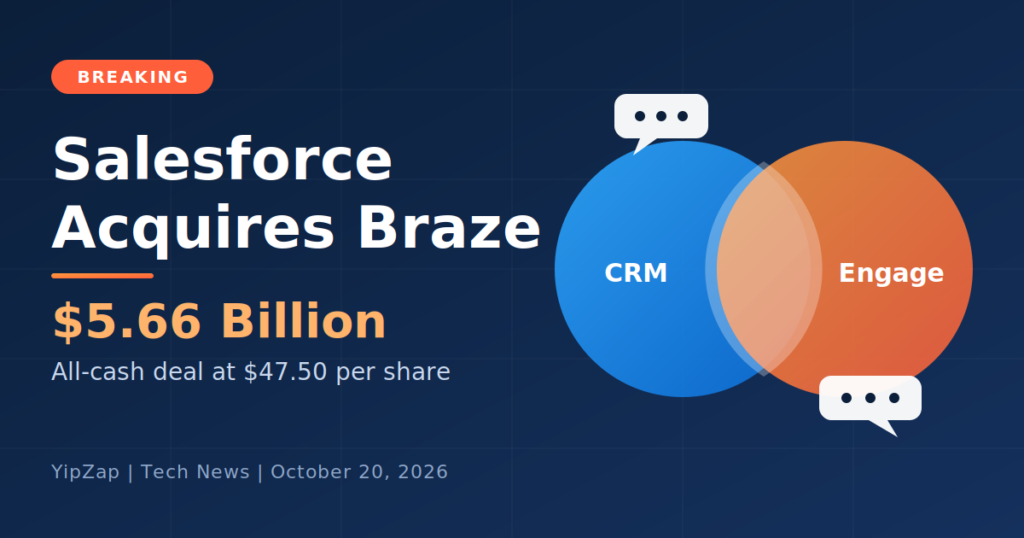
Salesforce acquires Braze in an all-cash deal valued at about $5.66 billion in enterprise value, the company announced on October 20, 2026. The purchase gives the CRM giant a real-time customer messaging engine used by some of the biggest consumer brands in the world.
Braze shareholders will receive $47.50 in cash for each Class A share. Salesforce expects the deal to close during its fiscal year 2028, which runs from February 2027 to January 2028. Braze shareholders must approve it, and regulators must clear it first. Salesforce says the purchase changes nothing in its fiscal 2027 guidance, and it has not yet issued fiscal 2028 targets.
Salesforce Acquires Braze: Price, Terms and Timeline
The headline number is $5.66 billion, paid entirely in cash. That figure works out to roughly 6.3 times the midpoint of Braze’s fiscal 2027 revenue guidance, based on our own calculation. It also lands close to the valuation Braze carried when it went public on Nasdaq in November 2021, when its IPO priced at $65 per share and valued the company at nearly $5.9 billion.
Takeover talk around Braze is not new. In late 2024, with its shares down sharply for the year, analysts and investors floated Salesforce and Adobe as logical buyers. Now Salesforce has made the move.
J.P. Morgan is advising Salesforce, with Wachtell Lipton and Covington & Burling as legal counsel. Qatalyst Partners is advising Braze, and Davis Polk is its legal counsel.
What Braze Does and Who Uses It
Braze runs a customer engagement platform that lets marketers react to customer behavior the moment it happens. Brands use it to coordinate personalized messages across mobile apps, websites, email, SMS and WhatsApp. Its event-streaming design updates customer profiles continuously and handles trillions of messages and journey actions every year.
The company also sells BrazeAI, a set of tools that optimizes content, offers, channels and timing for each customer. Braze serves about 2,770 customers, including Canva, Dairy Queen, Equinox, Instacart, Urban Outfitters and Venmo. Co-founders Bill Magnuson and Jon Hyman lead the company from its New York headquarters, and it operates 15 offices across the Americas, EMEA and Asia-Pacific.
Braze Revenue, Growth and Financial Performance
Braze enters the deal with strong momentum. For its fiscal first quarter of 2027, which ended April 30, 2026, the company posted revenue of $211.0 million. That is up 30.2 percent from $162.1 million a year earlier. Organic growth reached 27 percent, and the company called it the fourth straight quarter of accelerating organic growth. The gap between reported and organic growth points to acquired revenue, including its earlier purchase of the AI decisioning firm OfferFit.
Subscription revenue made up most of the total at $195.2 million, up from $154.9 million. Professional services and other revenue more than doubled to $15.8 million from $7.2 million. GAAP gross margin slipped to 65.7 percent from 68.6 percent a year before.
Customer metrics also moved up. Trailing twelve month dollar-based net retention rose to 110 percent. The number of customers paying at least $500,000 in annual recurring revenue climbed to 349 from 262.
Braze raised its outlook after that quarter. It now expects fiscal 2027 revenue of $895 million to $899 million, with non-GAAP operating income of $70 million to $74 million and non-GAAP earnings of $0.61 to $0.65 per share. For the second quarter, it guided to revenue between $219.5 million and $220.5 million.
Why Salesforce Wants Braze
Salesforce frames the purchase around the shift toward AI agents that understand customers and act in real time. Patrick Stokes, who runs applications and marketing at Salesforce, said knowing a customer and responding at the right moment drives the best experiences. He plans to combine Braze with Marketing Cloud, CRM and Data 360 to deliver that.
Salesforce expects Braze to complement all four layers of its architecture: Data 360, Customer 360, Agentforce and SIForce. Inside Customer 360, Braze should strengthen Marketing Cloud’s cross-channel personalization at the scale of hundreds of millions of people. The strategy leans on Braze’s strength in high-volume consumer marketing and its deep mobile and in-app tools. Both companies also say they favor an open, composable approach that lets customers choose their own data tools and partners.
What Happens Next for Braze Customers
For now, Braze keeps operating as an independent company. Magnuson says the team will keep building under the Braze name and keep investing in its customers and partners. He credits Salesforce’s platform with helping Braze ship new features faster.
Several hurdles remain before the deal closes. Braze will file a proxy statement for its shareholder vote, and regulators in the relevant markets must approve the transaction. Salesforce has also noted risks such as integration problems, key staff leaving, and the chance that a rival bid emerges. Marketers who rely on Braze should watch for those filings and for any product roadmap updates once the deal gets closer.