






Grigori Perelman is the only person in history to solve a Millennium Prize Problem, one of seven legendary math puzzles that the Clay Mathematics Institute attached a $1 million reward to in the year 2000. The reclusive Russian mathematician proved the Poincaré conjecture in 2002 and 2003, then turned down the Fields Medal in 2006 and the million-dollar prize in 2010. No other Millennium Prize Problem has been officially declared solved, and that is why Perelman remains one of the most talked-about figures in modern mathematics.
In this guide, you will learn who Grigori Perelman is, what the Poincaré conjecture means in simple words, how he solved it, why he walked away from the money and the medal, and where he is today. We also look at the AI claims on other Millennium Problems in 2026, and at the Grigori Perelman memes that made him an internet legend.
Why Grigori Perelman Became an Internet Legend
Perelman’s story has everything the internet loves: a nearly impossible problem, a shy genius, a huge prize and a firm “no.” Meme makers turned that into dozens of formats. Here are the best Grigori Perelman memes that show why the story keeps spreading.
The “I Can Fix Him” Meme
In this starter-pack style meme, Perelman walks past the things linked to his name: the sphere and donut from topology, the Navier–Stokes equation, the P versus NP circles and even a cup of coffee. The joke is that mathematicians would love to bring him back to work on the remaining problems.

Perelman and the Gigachad Format
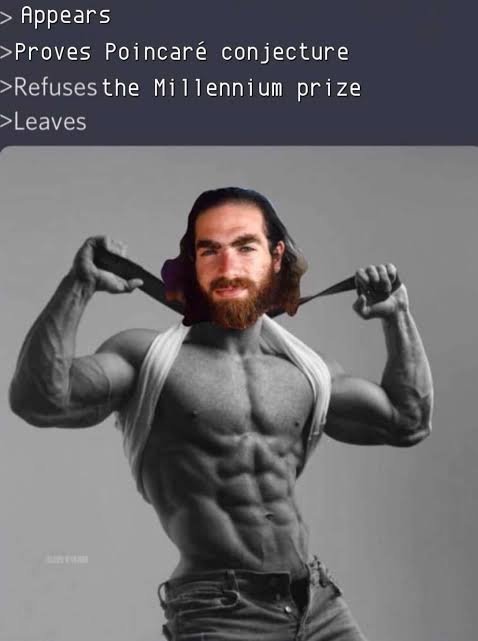
Another favorite puts Perelman’s face on the Gigachad body. The text is simple: appears, proves the Poincaré conjecture, refuses the Millennium Prize, leaves. It gets the whole story across in four short lines.
The Drake Meme: Fields Medal and Cash
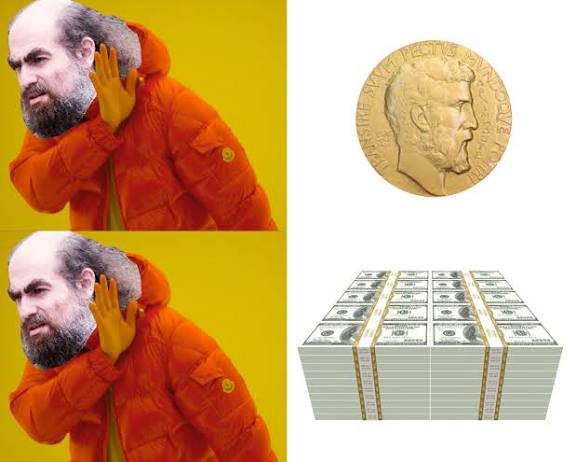
In the Drake format, Perelman raises his hand to reject the Fields Medal and then does the same to a pile of cash. It is the quickest way to explain why people respect him.
“And Accept the Fields Medal and Million Dollar Prize, Right?”
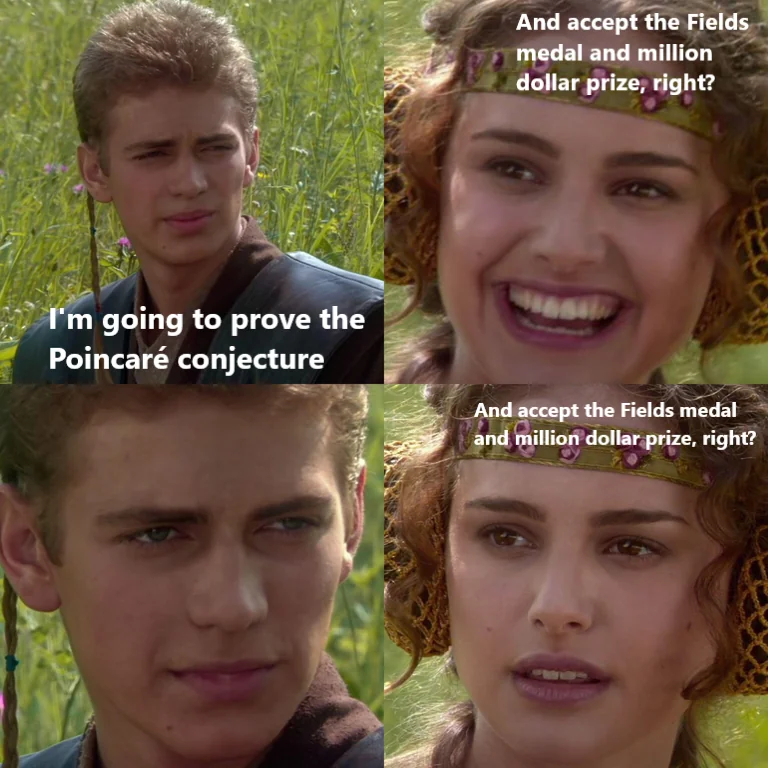
This Anakin and Padmé meme works because of the pause at the end. Everyone expects the happy ending where he collects the prize, and the silence in the last panel answers for him.
The Perelman Apology Form
This joke form mocks the ways the math world treated him, with checkboxes about plagiarism, ignoring his concerns and treating him like an animal in a zoo. It reflects how many fans see his decision to step away: as a protest about ethics, not about money.

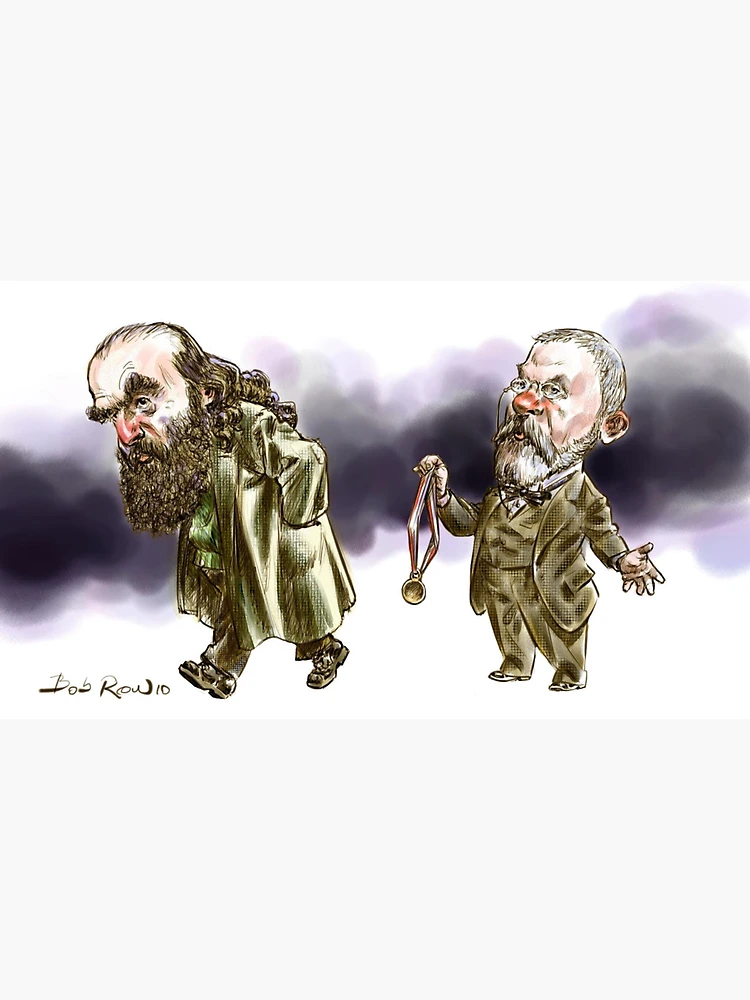
The Caricature of Perelman Walking Away
This illustration shows Perelman strolling away while Henri Poincaré holds out a medal behind him. It tells the story in one frame: the problem came from Poincaré, and the medal is left hanging.
Grigori Perelman: Quick Facts
- Full name: Grigori Yakovlevich Perelman
- Born: June 13, 1966, in Leningrad (now Saint Petersburg), Soviet Union
- Solved: The Poincaré conjecture, as part of Thurston’s geometrization conjecture
- Proof published: Three papers posted online between November 2002 and July 2003
- Fields Medal: Offered on August 22, 2006, and declined
- Millennium Prize: Announced on March 18, 2010, and declined on July 1, 2010
- Prize money refused: $1,000,000
- Lives in: Saint Petersburg, Russia, away from public life
Who Is Grigori Perelman?
Grigori Perelman was born in Leningrad in 1966 to a family that valued learning. His mother, Lyubov, had studied mathematics and gave up graduate work to raise him. She noticed his talent early and enrolled him in an after-school math program when he was about ten years old. He then studied at Leningrad Secondary School 239, a school known for its strong math and physics classes.
At 16, Perelman joined the Soviet team at the 1982 International Mathematical Olympiad in Budapest. He won a gold medal with a perfect score. He went on to Leningrad State University, finished his PhD in 1990, and began working at the Steklov Institute of Mathematics in his home city.
In the early 1990s, he spent time at American universities, including New York University and the University of California, Berkeley. In 1994, he proved the soul conjecture, a geometry problem that had stayed open for about twenty years. Top US universities, including Princeton and Stanford, offered him jobs. He said no and returned to Saint Petersburg in 1995 for a research-only position. That choice was an early sign of how he thinks about career, money and status.
What Is the Poincaré Conjecture? A Simple Explanation
The Poincaré conjecture is a question about shapes. Think of a rubber band stretched around an apple. You can slide the band slowly toward one point and shrink it down without tearing it or leaving the surface. Now try the same trick on a donut and the band gets stuck around the hole. The apple surface is a sphere, and mathematicians say it is “simply connected,” which means every loop on it can shrink to a point.
In 1904, the French mathematician Henri Poincaré asked whether the same idea works one dimension higher. If a closed three-dimensional space has the property that every loop can shrink to a point, must that space be the three-dimensional version of a sphere? For almost a century, nobody could prove it.
Mathematicians did solve higher-dimensional versions first. Stephen Smale handled dimensions above four in 1961, and Michael Freedman solved the four-dimensional case in 1982. The three-dimensional case, the original and hardest one, stayed wide open until Perelman.
What Are the Millennium Prize Problems?
The Clay Mathematics Institute announced the seven Millennium Prize Problems on May 24, 2000, at the Collège de France in Paris. Each one carries a $1 million prize for a correct solution. The seven problems are:
- The Poincaré conjecture (solved)
- The Riemann hypothesis
- P versus NP
- The Navier–Stokes existence and smoothness problem
- The Yang–Mills existence and mass gap problem
- The Hodge conjecture
- The Birch and Swinnerton-Dyer conjecture
The Clay Institute has a strict process. A solution must appear in a qualifying publication, at least two years must pass, and the wider math community must accept it. Only the Poincaré conjecture has completed that journey so far, which makes Grigori Perelman the only person whose work the Institute has officially recognized with a Millennium Prize.
How Grigori Perelman Solved the Poincaré Conjecture
Perelman did not post his work in a journal. In November 2002, he uploaded a paper to the open arXiv server. He followed it with a second paper in March 2003 and a short third paper in July 2003. Together, these three papers proved Thurston’s geometrization conjecture, a much bigger statement that contains the Poincaré conjecture as a special case.
The Ricci Flow Idea
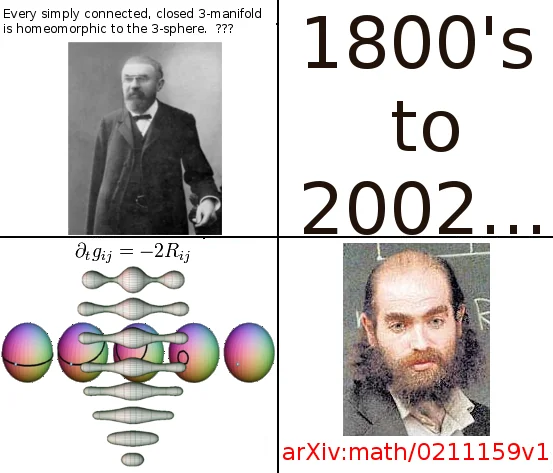
The tool at the center of the proof is the Ricci flow, an equation introduced by the American mathematician Richard Hamilton in the early 1980s. It works like the heat equation. Heat spreads out until the temperature evens out, and Ricci flow spreads out curvature until a shape becomes smoother and more uniform. The meme above shows this equation next to Perelman’s face for a reason.
Hamilton knew that the flow can develop “singularities,” points where the curvature blows up. He built a plan, now called the Hamilton program, but he could not control those trouble spots in three dimensions.
Surgery and Singularities
Perelman supplied the missing pieces. He showed that, at tiny scales, every singularity in a three-dimensional Ricci flow looks like either a shrinking sphere or a shrinking cylinder. That insight let him perform “surgery”: cut out the bad region, cap the open ends, and let the flow continue. His third paper showed that for spaces matching the Poincaré conjecture, the process ends in finite time, and the shape turns out to be a sphere.
How the Proof Was Checked
Perelman’s papers were short and skipped many details, so other experts filled in the gaps. Bruce Kleiner and John Lott posted detailed notes. Huai-Dong Cao and Xi-Ping Zhu published a full account in 2006. John Morgan and Gang Tian wrote another detailed version. At the 2006 International Congress of Mathematicians, Morgan reported that the work had been thoroughly checked. In December 2006, a leading science journal named the proof its Breakthrough of the Year, the first time a math result earned that title.
Why Grigori Perelman Refused the Fields Medal and $1 Million
The Fields Medal is often called the Nobel Prize of mathematics. On August 22, 2006, at the congress in Madrid, organizers offered it to Perelman for his work on Ricci flow. He did not attend, and he became the only person ever to decline the medal. The head of the International Mathematical Union had traveled to Saint Petersburg and spent about ten hours trying to change his mind. Perelman said the prize was irrelevant to him, because a correct proof needs no other recognition.
On March 18, 2010, the Clay Institute announced that Perelman had met the conditions for the first Millennium Prize. A ceremony in Paris took place on June 8, 2010, and he did not show up. On July 1, 2010, news reports said he formally refused the $1 million.
He gave two reasons. First, he felt Richard Hamilton deserved as much credit as he did, so the decision felt unfair. Second, he said he disagreed with the organized mathematical community and its decisions, which he considered unjust. In earlier remarks, he also said he did not want to be put on display like an animal in a zoo. The Clay Institute later used the prize funds to create a temporary research chair for young mathematicians at the Institut Henri Poincaré in Paris.

Where Is Grigori Perelman Now?
Perelman resigned from the Steklov Institute in December 2005 and has lived quietly in Saint Petersburg ever since. In 2006, he said he had left professional mathematics because he was disappointed with the ethical standards he saw in the field. He has avoided interviews since then, and reporters who reached him by phone were turned away. A biographer who tried to meet him was also unable to.
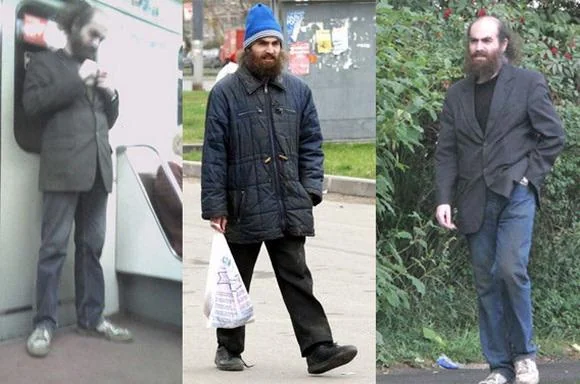
Some friends and colleagues have said he still thinks about math. Reports over the years have linked his interest to fluid equations such as Navier–Stokes, but there is no confirmed new paper from him. Photos of him walking around Saint Petersburg with a shopping bag have spread widely online and fed the myth.
Is Grigori Perelman Really the Only Person to Solve a Millennium Problem?
Yes, officially. As of November 2026, the Poincaré conjecture is the only Millennium Prize Problem that the Clay Mathematics Institute counts as solved. The other six remain open in the Institute’s own list.
That said, 2026 brought new claims. In September 2026, OpenAI announced a result on the Navier–Stokes problem that it said resolves part of the official statement, and it added that it did not plan to claim the prize. The Clay Institute described the problem as apparently settled, but it stressed that its normal rules still apply. Those rules ask for peer-reviewed publication and a waiting period of at least two years, and independent mathematicians are still checking the work. In November 2026, mathematician Levent Alpöge also claimed a proof related to the Riemann hypothesis, which many people are now examining.

Grigori Perelman Timeline
| Year | What happened |
|---|---|
| 1904 | Henri Poincaré asks his famous question about three-dimensional spheres |
| 1961 | Stephen Smale proves the conjecture for dimensions above four |
| 1966 | Grigori Perelman is born in Leningrad |
| 1982 | Perelman wins gold at the Math Olympiad with a perfect score; Michael Freedman solves the four-dimensional case |
| 1994 | Perelman proves the soul conjecture |
| 2000 | The Clay Institute announces the seven Millennium Prize Problems |
| 2002–2003 | Perelman posts three papers on Ricci flow, covering the Poincaré and geometrization conjectures |
| 2005 | He resigns from the Steklov Institute |
| 2006 | He declines the Fields Medal; his proof is named Breakthrough of the Year |
| 2010 | The Clay Institute announces the Millennium Prize; Perelman refuses it |
| 2026 | AI-linked claims on other Millennium Problems spark a new debate, and Perelman memes surge again |
Grigori Perelman FAQ
Who is Grigori Perelman?
Grigori Perelman is a Russian mathematician born in 1966 who proved the Poincaré conjecture. He is the only person whose solution to a Millennium Prize Problem has been officially recognized.
Which Millennium Prize Problem did Perelman solve?
He solved the Poincaré conjecture, a question about three-dimensional shapes that Henri Poincaré posed in 1904. His proof also covers the larger geometrization conjecture.
Why did Grigori Perelman refuse $1 million?
He said he disagreed with the organized mathematical community and felt the decision was unfair to Richard Hamilton, whose Ricci flow work made the proof possible. He also said he did not want fame or public attention.
Did Perelman also refuse the Fields Medal?
Yes. He was offered the Fields Medal in 2006 and declined it, which made him the only person to ever refuse that honor.
Is Perelman the only person who solved a Millennium Problem?
Officially, yes. The Clay Mathematics Institute still lists the other six problems as unsolved, and it has a strict review process that includes a waiting period of at least two years after publication.
Where does Grigori Perelman live today?
He lives in Saint Petersburg, Russia, and has avoided journalists and public events for many years.
How did Perelman prove the Poincaré conjecture?
He used Hamilton’s Ricci flow, added new tools to control singularities, and introduced a surgery method that cuts out trouble spots. His three papers appeared on arXiv between 2002 and 2003.
Final Thoughts
Grigori Perelman solved a problem that stood for a century, then chose a quiet life over a medal and $1 million. Whether you see him as a hero, a mystery or just a meme, his story shows that some people care more about the idea than the reward. As new claims on the Riemann hypothesis and Navier–Stokes make headlines, Perelman’s name is a reminder of what a fully checked and accepted solution looks like.