






1. Euler’s Identity Meme Explained: Why Mathematicians See e^iπ as Pokemon Cards
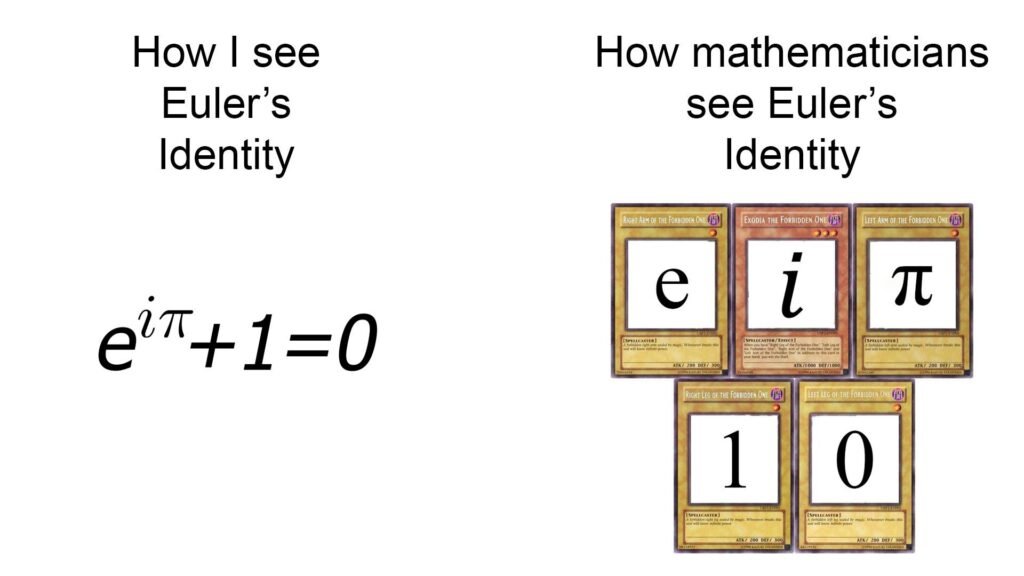
Even if you slept through calculus, you’ve probably heard Euler’s identity described as ‘the most beautiful equation in mathematics.’ But while most people see a scary formula, mathematicians see five legendary Pokémon cards—each one a mathematical constant that deserves its own trading card. This meme perfectly captures why mathematicians lose their minds over this equation
2 . Euler’s 30-Year Equation: First-Year Math Test Meme Explained
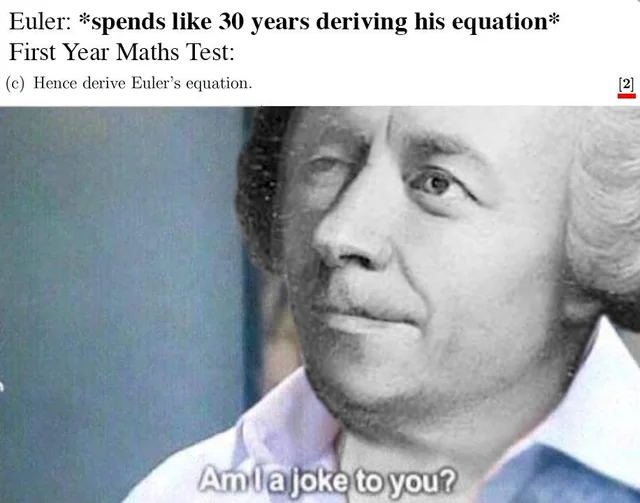
Euler’s famous equation was created after 30 years of hard mathematical work. But first-year students are expected to understand and solve this same equation in just one exam. This meme shows how unfair this is. Teachers ask students to learn in a few weeks what took a genius 30 years to figure out. The equation is treated like it’s easy, when it’s actually very difficult.
3. e^x Meme: Why Calculus Students Love This Therapy Joke Explained
![Four-panel meme showing a parent taking e^x to a Differentiative Center therapy where the derivative d/dx[e^x] doesn't help, then to an Integrative Medical Institute where the integral ∫e^x dx + C finally succeeds, humorously illustrating calculus properties.](https://yipzap.com/wp-content/uploads/2026/06/euler-5th-meme-1.jpeg)
This meme is about the exponential function e^x going to therapy. The parent tries the Differentiative Center, but taking the derivative of e^x doesn’t help because the answer stays the same—it’s still e^x. Then they visit the Integrative Medical Institute where integration works. The integral of e^x becomes e^x plus C, which is different. This jokes about how integration actually changes e^x, while differentiation leaves it unchanged, making e^x unique in calculus.
4. Virgin Newton vs Chad Euler Meme: The Ultimate Mathematician Comparison

This meme compares two famous mathematicians’ personalities. Newton was competitive and mean—he fought with other scientists and insulted people who challenged him. Euler was the opposite: humble, kind, and generous. He had many children but still helped everyone learn math without being rude. The joke shows that being a great mathematician doesn’t require being mean like Newton. Euler proved you can be brilliant, humble, and kind at the same time.
5.Math Before 18th Century vs Euler Meme: How One Man Changed Everything
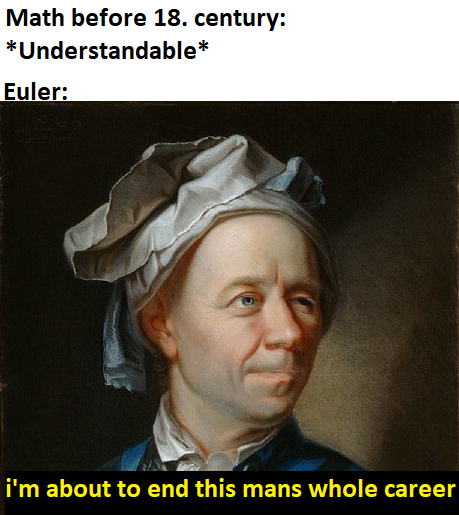
This meme jokes about how Euler changed everything in mathematics. Before the 1700s, math was simple and easy to understand. Then Euler arrived and invented so many new and difficult concepts that he basically made old mathematics look primitive. The meme says ‘I’m about to end this man’s whole career’—meaning Euler ruined the careers of previous mathematicians by making his work so advanced and complex that it overshadowed everything before him
Leonhard Euler: The Greatest Mathematician Who Ever Lived
Who Was Leonhard Euler?
Leonhard Euler was a Swiss mathematician, physicist, and engineer widely recognized as one of the greatest mathematicians of all time. Born in the 18th century, Euler revolutionized nearly every branch of mathematics through his prolific work and groundbreaking discoveries. He created over 886 published works during his lifetime and continued working until his death, establishing fundamental concepts that scientists and mathematicians still use today.
His contributions span across calculus, graph theory, topology, combinatorics, complex analysis, and numerous other mathematical fields. Euler’s work formed the foundation for modern mathematics and influenced virtually every area of scientific research that followed.
Birth and Early Life
Born: April 15, 1707 in Basel, Switzerland
Leonhard Euler was born into a Protestant clergy family in Basel, one of Switzerland’s most important cities. His father, Paul Euler, was a minister and mathematician who provided his early education. His mother, Marguerite Brucker, came from a clergy family as well. From childhood, Euler demonstrated exceptional mathematical ability and was recognized as a prodigy.
At age 13, Euler enrolled at the University of Basel, where he studied philosophy, theology, and mathematics. He completed his studies remarkably quickly and received his master’s degree before his 18th birthday. Despite his family’s expectation that he would become a minister, Euler’s passion for mathematics prevailed, and he dedicated himself to mathematical research.
Where Did Euler Live?
Basel, Switzerland (1707-1727)
Euler spent his early years in Basel, where he received his education and began his mathematical career. He worked briefly as a lecturer at the University of Basel before seeking greater opportunities for research and collaboration.
Saint Petersburg, Russia (1727-1741)
At age 20, Euler accepted a position at the Imperial Russian Academy of Sciences in Saint Petersburg, one of the most prestigious mathematical institutions in Europe. This move proved transformative for his career. He became a full professor of mathematics at the Academy and published extensively during his 14 years there. Saint Petersburg provided him with resources, intellectual stimulation, and freedom to pursue his research without restrictions.
During his time in Russia, Euler produced some of his most important mathematical work and established himself as Europe’s leading mathematician. Despite living far from his native Switzerland, he remained highly productive and connected with the European mathematical community through correspondence.
Berlin, Prussia (1741-1766)
Euler spent 25 years in Berlin, Germany (then Prussia), serving as the Director of Mathematics at the Berlin Academy under King Frederick II. This period was extraordinarily productive—he published over 300 works during these 25 years. His work at the Berlin Academy solidified his reputation as the most important mathematician in Europe.
Saint Petersburg, Russia (1766-1783)
Euler returned to Saint Petersburg at age 59 and remained there for the final 17 years of his life. Despite losing his eyesight completely (he had already lost one eye), he continued his mathematical work with remarkable determination. He dictated his work to assistants and continued producing groundbreaking mathematical discoveries until his death.
Family Life
Marriage & Children: In 1734, Euler married Katharina Gsell, the daughter of a Swiss painter who had come to Russia. They had a long and stable marriage that lasted over 40 years. Despite his demanding work schedule and frequent moves across Europe, Euler maintained a devoted family life.
Children: Euler and Katharina had 13 children together—an exceptionally large family by any standard. Of these:
- 8 children died in infancy (tragically common in the 18th century)
- 5 children survived to adulthood
- Several of his sons became respected mathematicians and scientists themselves
Personal Characteristics: Unlike Newton’s legendary arrogance and competitiveness, Euler was known for his humility, kindness, and generosity. He was deeply religious, maintaining strong faith throughout his life despite the scientific nature of his work. His colleagues noted his patient mentorship of younger mathematicians and his willingness to help anyone seeking to learn mathematics.
Euler was known to:
- Help struggling students and colleagues without expecting recognition
- Support his children’s education regardless of their career choices
- Maintain correspondence with mathematicians across Europe
- Work despite significant physical challenges (blindness in his later years)
- Continue his family responsibilities while conducting groundbreaking research
Major Works & Contributions
Euler’s Famous Equations:
1. Euler’s Identity (e^(iπ) + 1 = 0) Often called the most beautiful equation in mathematics, this formula connects five fundamental mathematical constants in a single elegant expression. It forms the foundation of complex analysis and has applications across physics, engineering, and beyond.
2. Euler’s Formula for Polyhedra (V – E + F = 2) This topological formula relates vertices, edges, and faces of any polyhedron, establishing fundamental principles of topology.
3. Exponential Function (e^x) Euler defined and extensively studied the exponential function, which has become essential in mathematics, physics, engineering, and natural sciences.
Mathematical Fields Pioneered:
- Graph Theory: Euler’s work on the Seven Bridges of Königsberg created modern graph theory
- Topology: He established fundamental principles that developed into modern topology
- Complex Analysis: His work with imaginary numbers revolutionized mathematics
- Calculus: Extended and systematized calculus beyond Newton and Leibniz
- Combinatorics: Made significant contributions to counting and probability theory
- Number Theory: Advanced prime number theory and number properties
- Mechanics & Physics: Applied mathematics to physical problems
Published Works:
Euler published over 886 works during his lifetime, and more were discovered and published after his death. His works filled over 80 volumes in the collected edition. His productivity was so extraordinary that the Saint Petersburg Academy took decades after his death just to publish all his remaining work.
Challenges & Achievements Despite Adversity
Blindness:
In 1738, Euler lost sight in one eye, possibly due to eye strain from his intensive work or from an infection. By 1766, he had become completely blind. Rather than retiring, Euler actually became MORE productive. With his exceptional memory and mental calculation abilities, he continued dictating work to assistants and produced some of his most important mathematical discoveries while completely blind.
Personal Losses:
Despite his large family and devoted wife, Euler experienced significant personal tragedy. Many of his children died in infancy, and his wife died in 1773. Yet he maintained his commitment to his work and continued supporting his remaining family members.
Continued Productivity:
Even in his final years—working blind, grieving lost family members, and living far from his birthplace—Euler remained intellectually active and continued to advance mathematical knowledge. His dedication to his work despite these enormous personal and physical challenges makes him an inspiration to scholars and scientists.
Death & Legacy
Death: September 18, 1783 in Saint Petersburg, Russia (age 76)
Euler died of a stroke while working in his study. He spent his final 17 years completely blind, yet produced some of his most important mathematical work during this period.
His Legacy:
Mathematical Impact:
- Created foundational concepts still taught in every mathematics classroom worldwide
- His notation and terminology became standard in mathematics
- His work spans nearly every mathematical discipline
- Over 50 mathematical concepts and theorems bear his name
- His methods and approaches form the basis of modern mathematics education
Personal Impact:
- Demonstrated that genius can be accompanied by humility and kindness
- Showed that adversity (blindness) need not prevent extraordinary achievement
- Proved that dedication to intellectual work can persist despite personal tragedy
- Established that a scientist can maintain faith and be deeply religious
- Modeled how to mentor and help others without seeking personal glory
Scientific Impact:
- His work became foundational for physics, engineering, and natural sciences
- Applications of his mathematics appear in modern technology, medicine, and research
- His graph theory work underlies computer science and network analysis
- His calculus and analysis work enables modern aerospace, architecture, and engineering
Interesting Facts About Euler
- Mental Calculator: Euler could perform complex calculations in his head and remember extensive mathematical tables
- Polyglot: He spoke multiple languages including German, French, Italian, Russian, and Latin
- Prolific Correspondent: He maintained correspondence with over 300 scientists and mathematicians across Europe
- Continued Work While Blind: His blindness didn’t slow him down—he was more productive blind than sighted
- Family Devotion: Despite his demanding career, he remained deeply committed to his family
- Religious Belief: Strongly religious throughout his life, contradicting the stereotype of atheist scientists
- Humble Despite Genius: Known for his modesty and willingness to acknowledge others’ contributions
- Worked Until Death: He was working on mathematical problems the day he suffered the stroke that killed him
Conclusion
Leonhard Euler represents the pinnacle of mathematical genius combined with personal character and perseverance. Born in Basel, he lived and worked across Europe—from Switzerland to Russia to Prussia—leaving an indelible mark on mathematics and science. His family, though large and marked by tragedy, was central to his life, and his kindness toward colleagues became legendary.
His 886+ published works continue to influence mathematics, physics, engineering, computer science, and countless other fields. In an age of specialization, Euler’s ability to master virtually every mathematical discipline remains unparalleled. Even centuries after his death, his work remains relevant, his notation continues in use, and his discoveries continue to inspire new generations of mathematicians and scientists.
Euler proved that extraordinary intellectual achievement need not come at the cost of humility, kindness, or personal integrity—a lesson that resonates far beyond mathematics into how we approach knowledge, community, and human potential.










2 Comments