






1. When Trigonometry meet Titanic
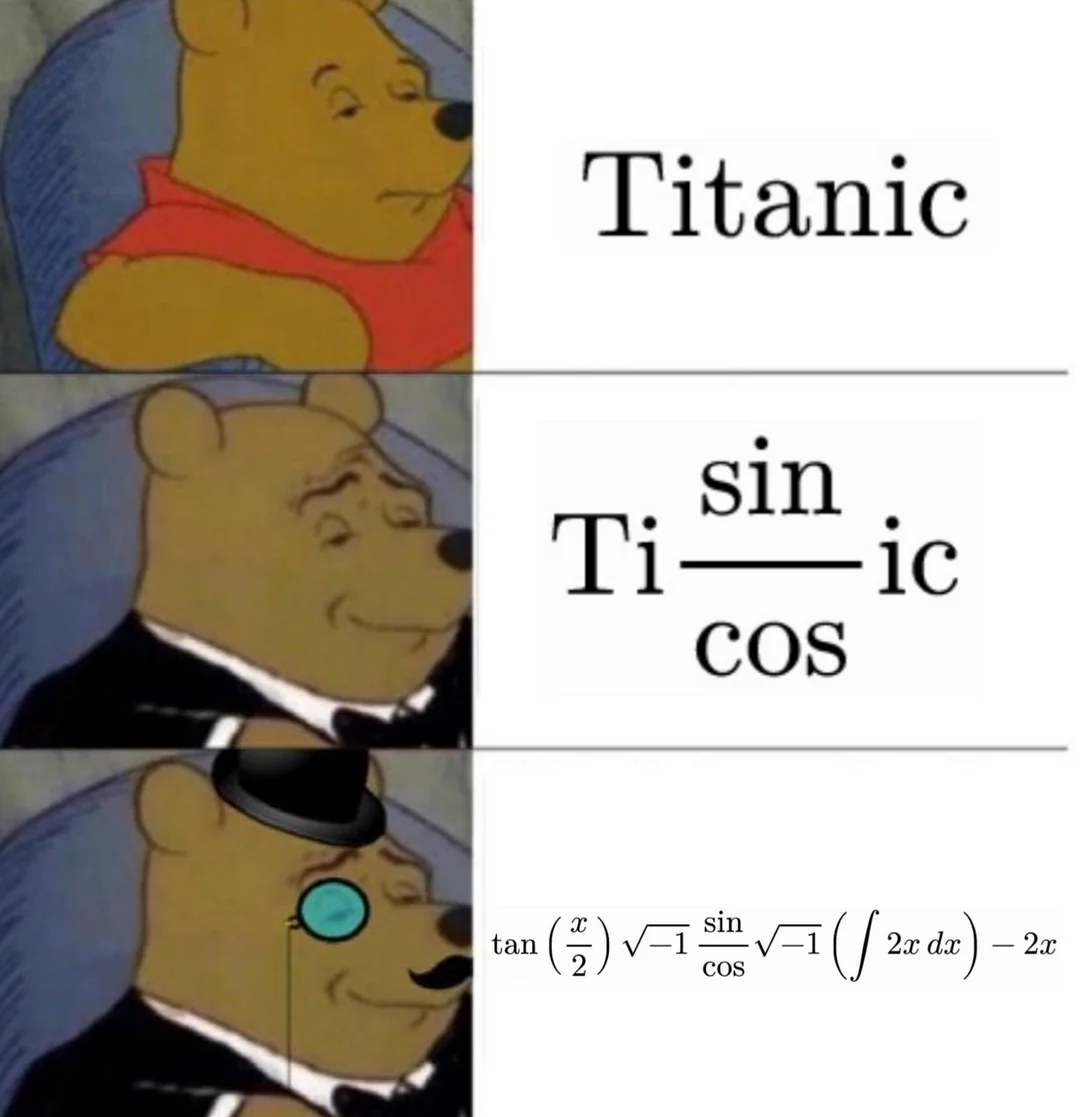
Trigonometry makes sine, cosine and tangent look scary, but with practice they become easy friends.
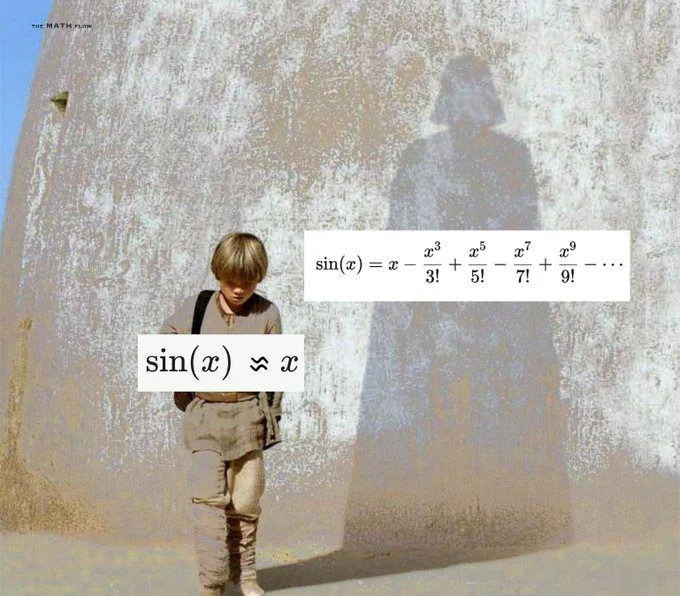
2. Engineers Prove sin(x) = x for Every Number
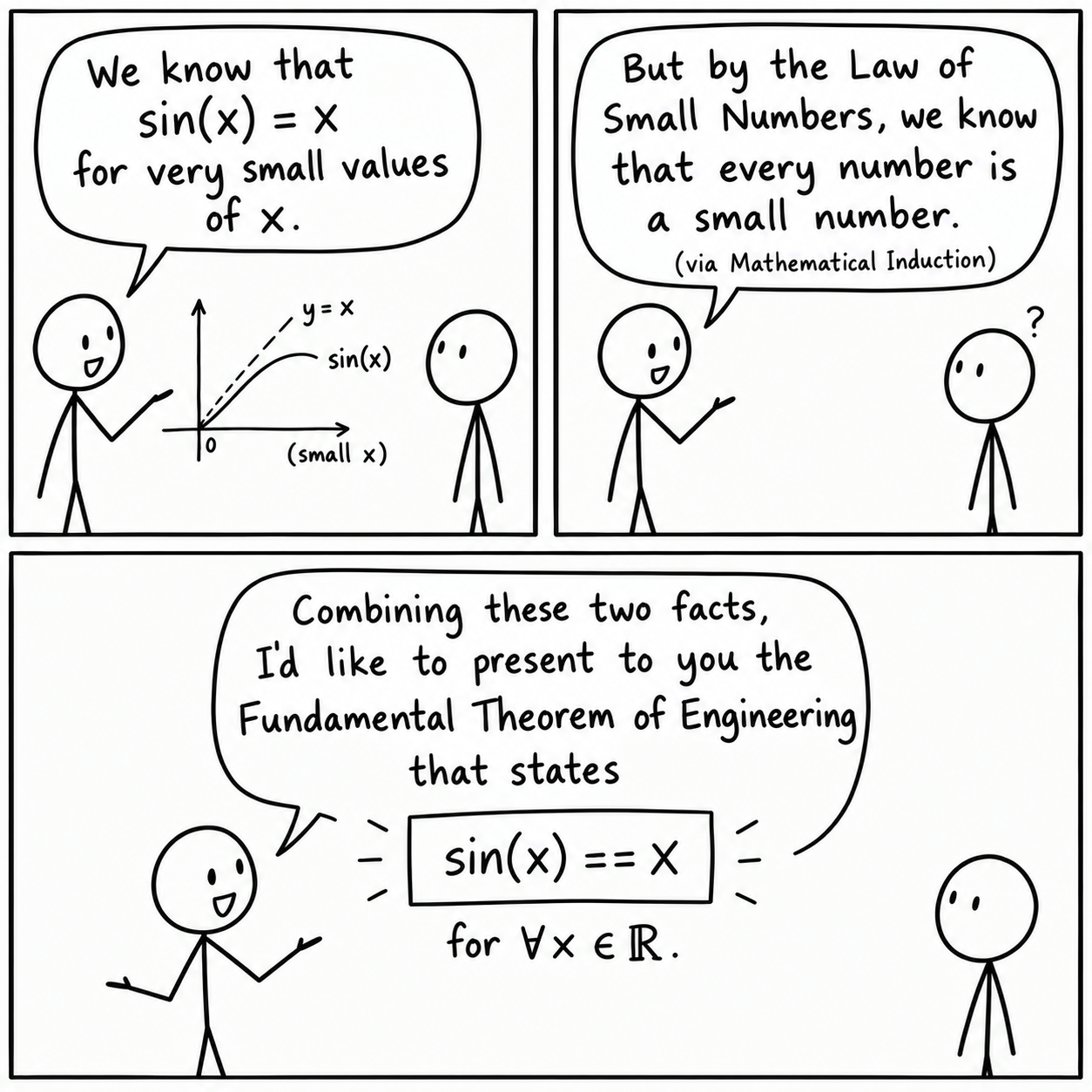
via u/Arnos_OP
Engineers say sin(x) equals x for small numbers, then claim every number is really small.
3. Trigonometry Functions as Mario Characters
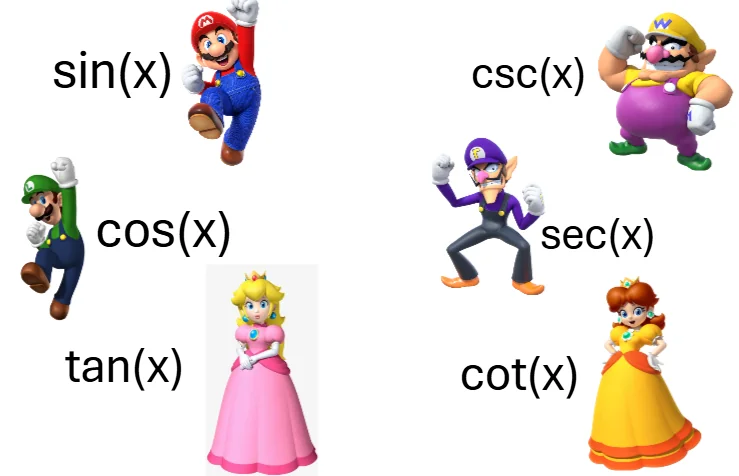
Sin is Mario, cos is Luigi, tan is Peach, and reciprocals are Wario, Waluigi, Daisy.
4. Four Fancy Ways to Write tan(q)
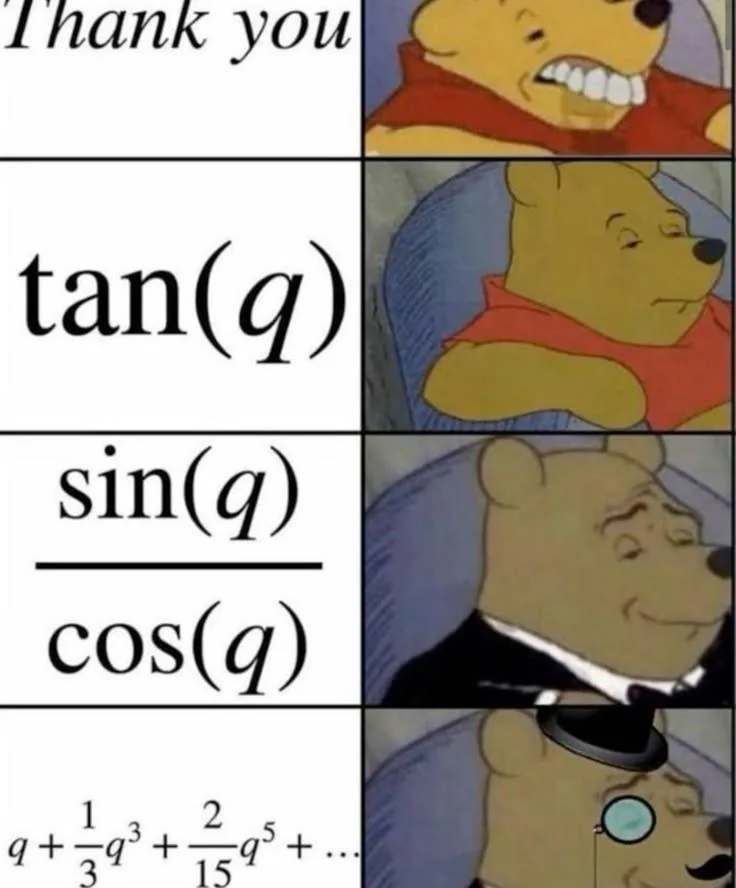
via u/CruchyWaffel
Same function, fancier forms: tan(q), then sin over cos, then its infinite power series expansion.
5. Trigonometric Justice: Sin 90 Times

Sin 90 and cot 45 both equal 1, so the joke twists math into crime.
6. Happy Tau Day: Celebrating 2π
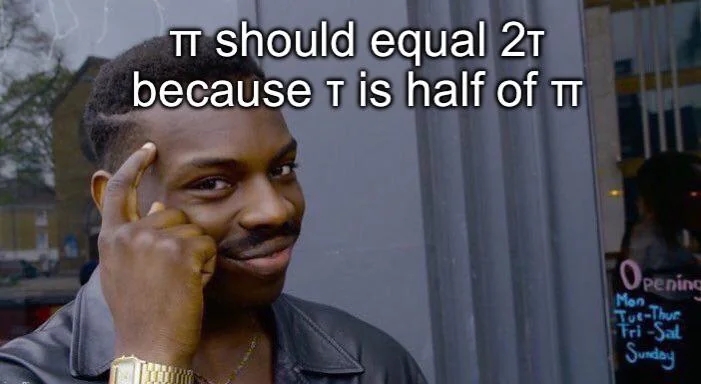
via u/hjkhhnnnlll
Tau equals two pi, so Tau Day celebrates a simpler circle constant some mathematicians prefer.
7. Sin: The Trigonometry Joke
via u/USERNAME
The joke plays on sin, the trigonometry function, sounding exactly like the word for wrongdoing.
8. What? Part 2: Math Confusion Continues
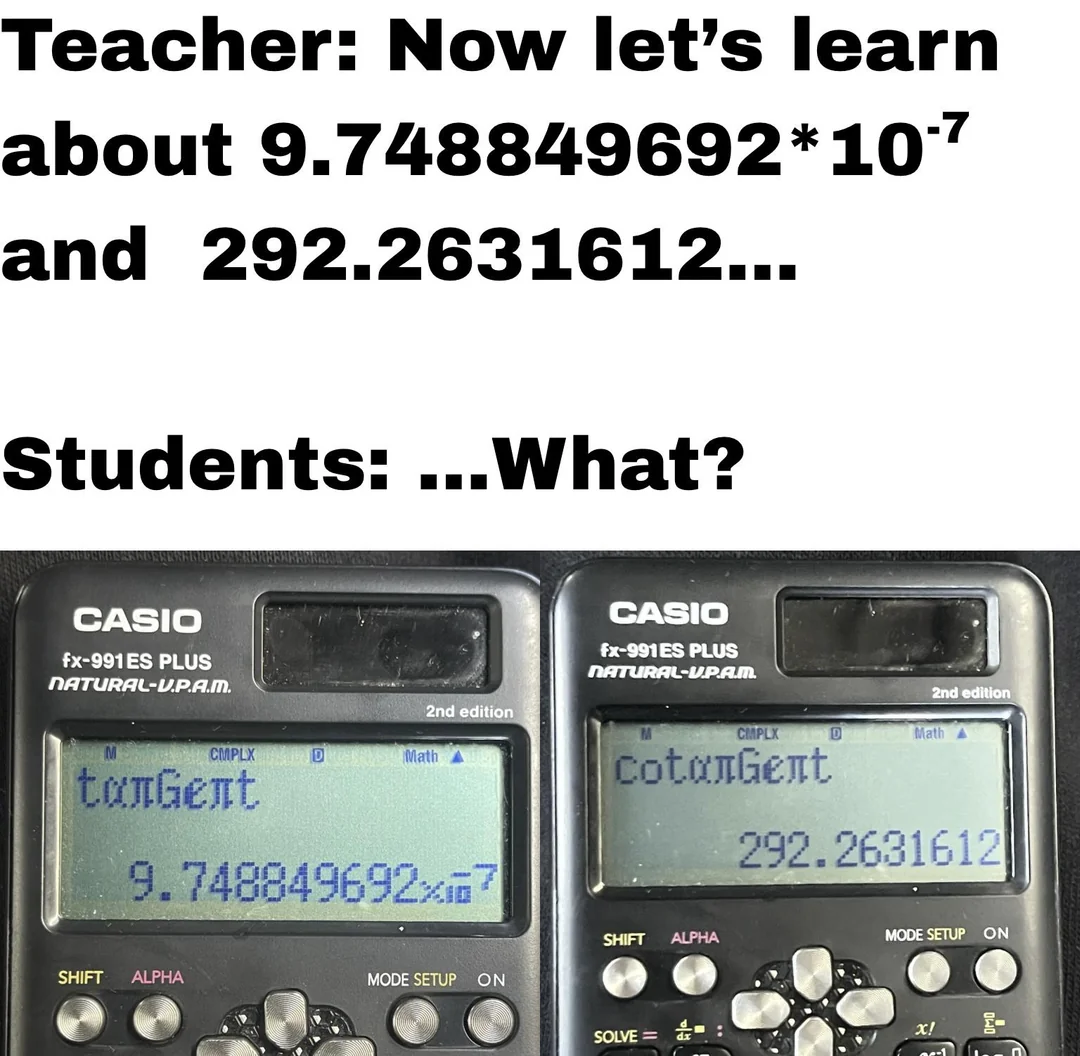
via u/absifinity
This meme is a sequel, showing another confusing math moment that leaves everyone saying “what?”
9. Chicken or Egg? Double or Half Angle?

via u/PAT_ball5230
Forget the chicken and egg; math fans argue about double angle versus half angle formulas.
10. The 7 Deadly Sins of Math
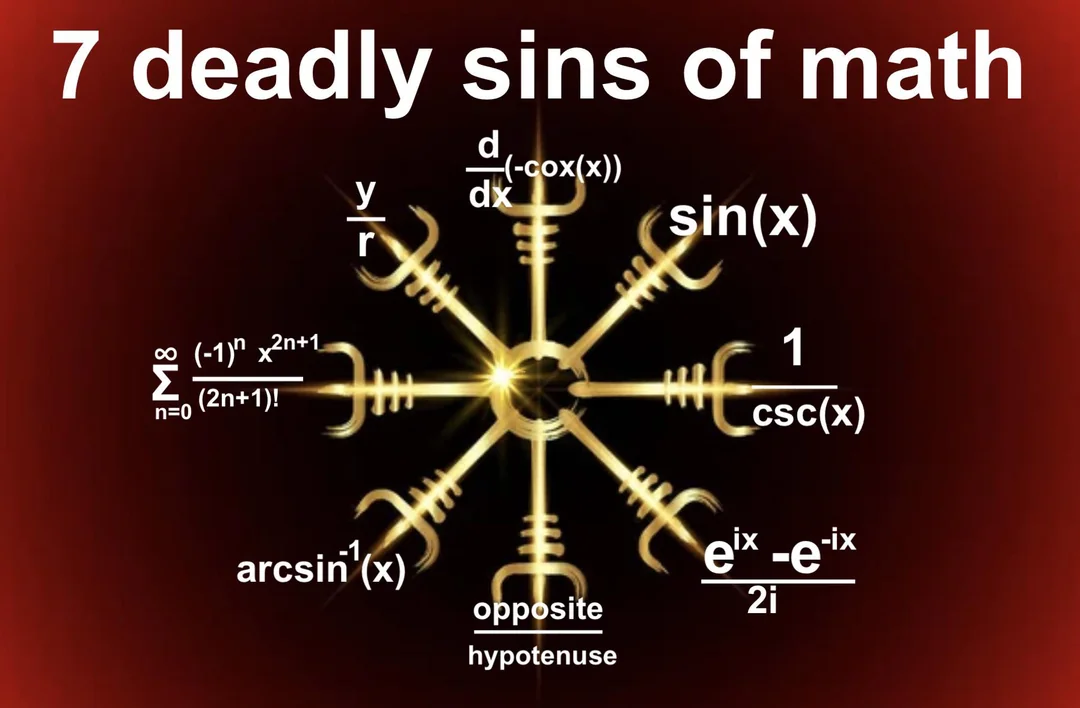
via u/s0wall
Sin sounds like “sin”, so the meme shows eight different ways to write sin(x).
Leave a Reply
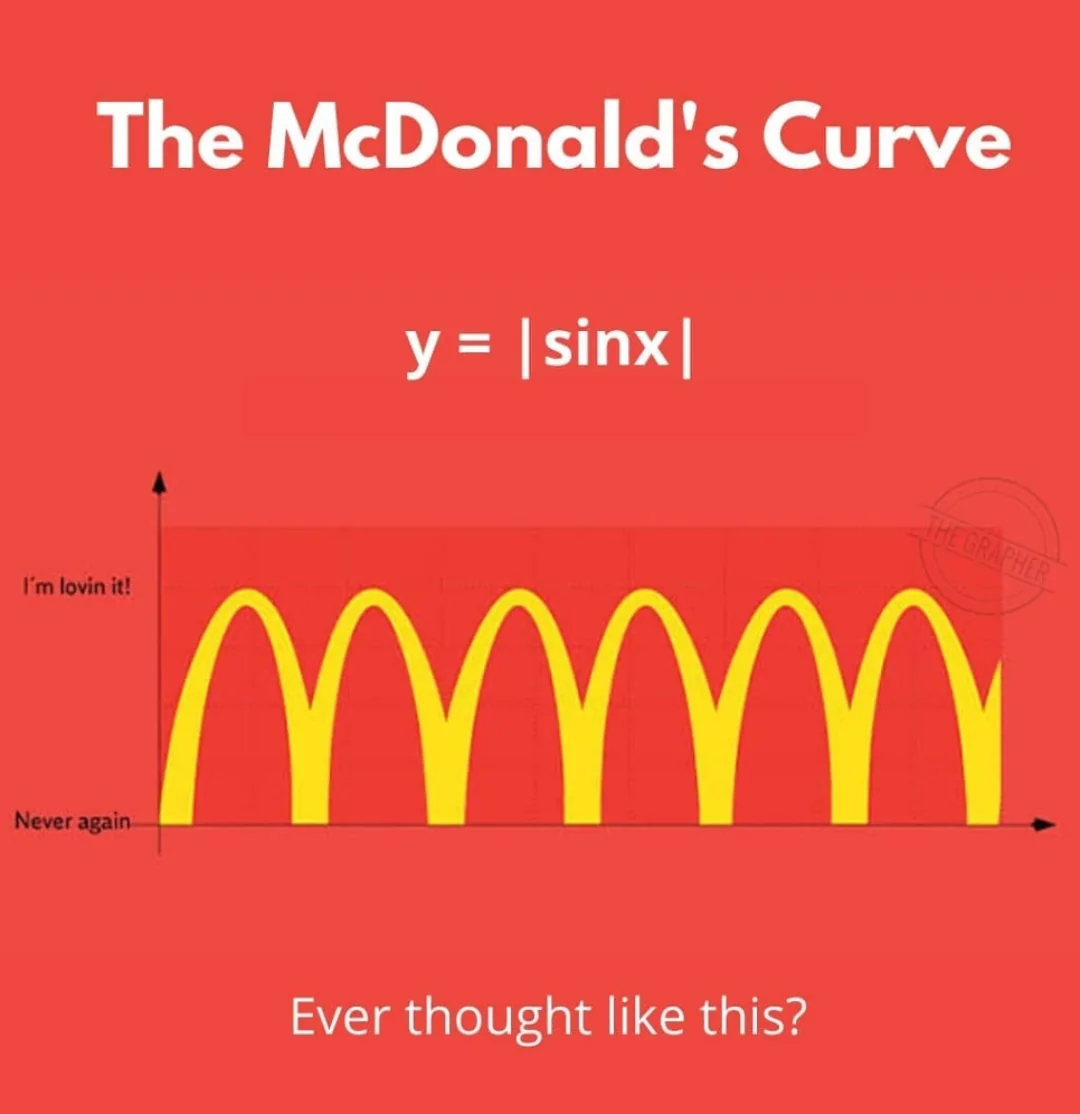
11. The McDonald’s Curve: y = |sin x|
via u/therealsaker
The graph of absolute sin x makes repeating arches that look exactly like McDonald’s golden logo.
Leave a Reply
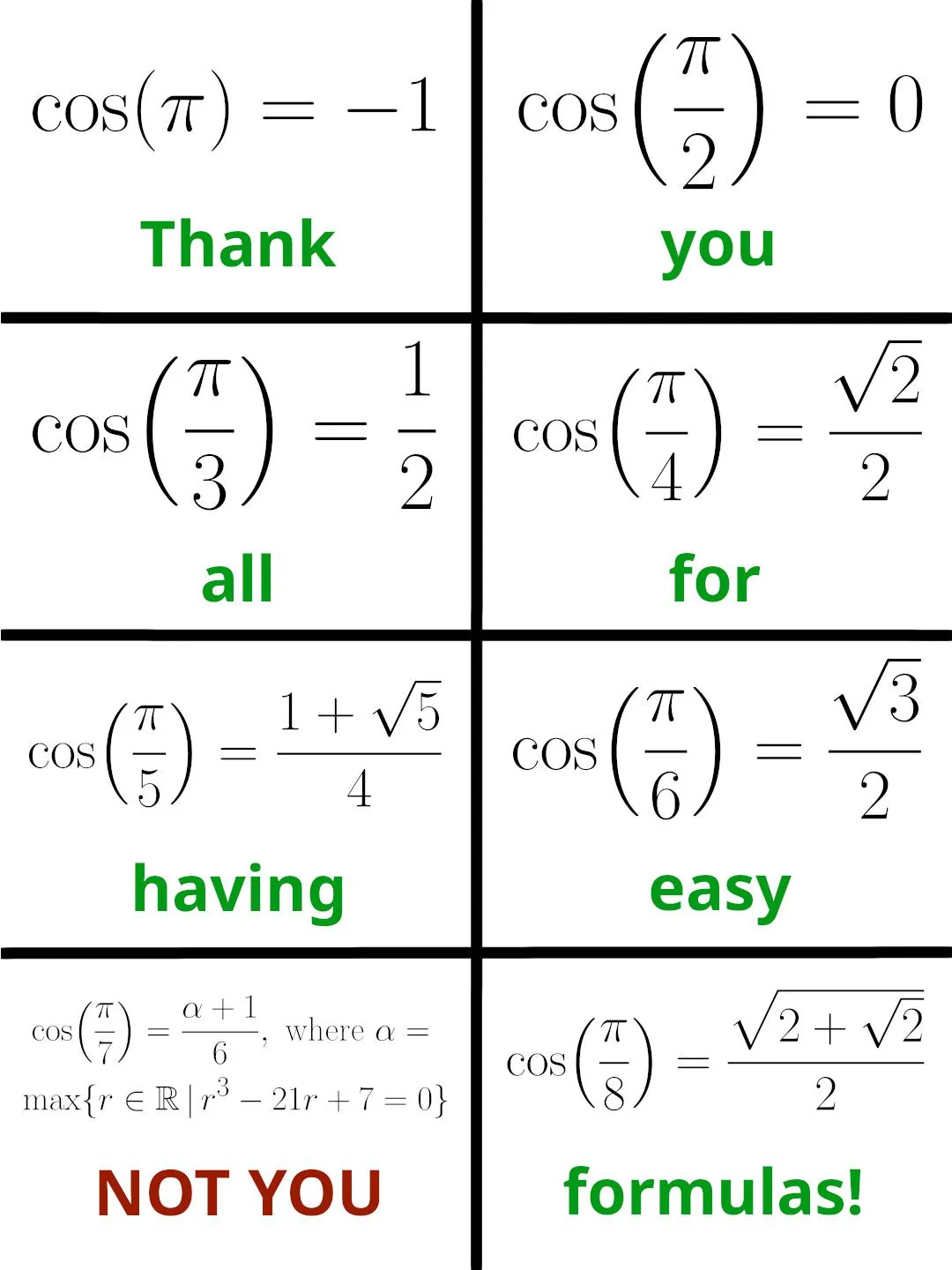
12. Thank You, Easy Cosine Values. Not You, π/7
via u/12_Semitones
Most cosine angles have simple answers, but cos(π/7) needs a messy cubic equation.
Leave a Reply
13. Trigonometry: Study of Triangles or Circles?
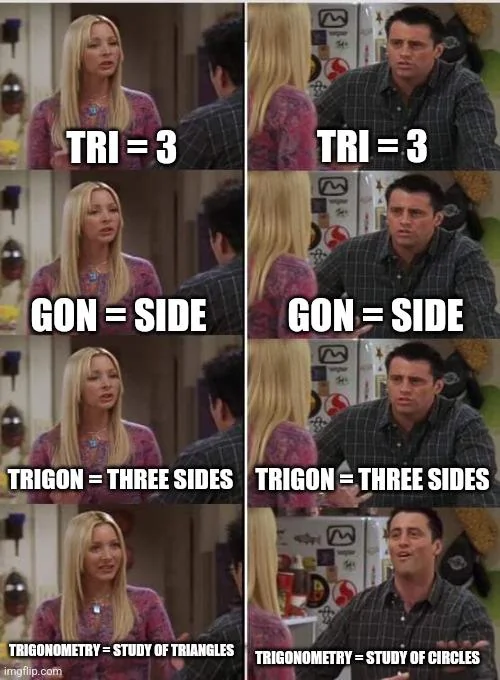
The name means three sides, yet one friend insists trigonometry is really about circles.
Leave a Reply
14. When You Remember Trigonometry Has Triangles

via u/26Hakon
Trigonometry feels like all circles, so remembering the triangles hits like a sleepless-night panic.
The History of Trigonometry: From Ancient Stars to Modern Technology
Our trigonometry memes are funny, but the subject behind them has a long and interesting story. The history of trigonometry is more than 3,500 years old. It started with people who looked at the sky, built pyramids and sailed across the sea. In this guide, you will learn who invented trigonometry, which mathematicians made it grow, and where we use it today. For a deeper timeline, you can also read the History of trigonometry on Wikipedia.
What Is Trigonometry?
The word trigonometry comes from Greek: trigonon means “triangle” and metron means “measure”. So trigonometry is the study of triangles and the relationships between their angles and sides. The main tools are the sine, cosine and tangent functions. Over time, trigonometry also became the study of circles and waves, which is exactly what meme 13 and meme 14 joke about. You can find a short definition in the Encyclopaedia Britannica article on trigonometry.
Where Did Trigonometry Begin? Ancient Egypt and Babylon
The first signs of trigonometry are very old.
- Ancient Egypt (about 1650 BCE): The Rhind Papyrus shows the seked, a way to measure the slope of a pyramid. This is similar to the idea of cotangent.
- Babylon (about 1800 BCE): The clay tablet Plimpton 322 lists number patterns linked to right triangles. Historians still debate exactly what it was used for. The Babylonians also gave us the 360-degree circle and the base-60 system we still use for angles and time.
Ancient Greece: The Birth of Trigonometry as a Science
- Hipparchus of Nicaea (about 190–120 BCE): Often called the “father of trigonometry”. He made the first known table of chords to study the stars and the Moon. His original work is lost, but later writers describe it. Read more in his MacTutor biography.
- Menelaus of Alexandria (about 70–140 CE): He wrote Sphaerica, a book on triangles drawn on a sphere. This is the base of spherical trigonometry.
- Claudius Ptolemy (about 100–170 CE): His book the Almagest contains a detailed chord table and a famous rule called Ptolemy’s theorem. Astronomers used this book for more than 1,000 years.
Ancient and Medieval India: The Birth of Sine and Cosine
Greek mathematicians used chords. Indian mathematicians moved to half-chords, which became the sine we know today. This was a big step, because sine is much easier to use in calculations.
- Baudhayana (about 800 BCE): His Sulba Sutra gives early rules about right triangles, used to build fire altars. This is similar to the Pythagorean theorem.
- Surya Siddhanta (about 4th–5th century CE): This astronomy book is one of the earliest works to use jya (sine), kojya (cosine) and utkrama-jya (versine).
- Aryabhata (476–550): In his book the Aryabhatiya, he gave a table of 24 sine values at steps of 3.75 degrees. He used the word jya for sine. See his MacTutor biography.
- Varahamihira (505–587): He improved the sine tables in the Pancha-Siddhantika.
- Bhaskara I (about 600–680): In the Mahabhaskariya, he gave a clever formula to estimate the sine of an angle without a table.
- Brahmagupta (598–668): In the Brahmasphutasiddhanta (628 CE), he created a method to estimate sine values between table entries (interpolation).
- Bhaskara II (1114–1185): In the Siddhanta Shiromani, he gave sine addition and subtraction formulas and studied trigonometry in detail.
Fun fact: The word sine has a strange history. The Sanskrit jya travelled to Arabic as jiba, which was read as jayb (meaning “fold” or “pocket”). Latin translators in the 12th century turned it into sinus, and that became “sine” in English.
The Indian School: Infinite Series 250 Years Before Europe
Between the 14th and 16th centuries, a group of mathematicians in India, made some of the most advanced discoveries in the history of trigonometry.
- Madhava of Sangamagrama (about 1340–1425): Founder of the indian school. He found infinite series for sine, cosine and arctangent about 250 years before Newton and Leibniz in Europe. These are now called the Madhava–Newton series. Learn more in his MacTutor biography.
- Parameshvara (about 1380–1460): He made accurate astronomical observations and gave a formula for the radius of the circle around a triangle.
- Nilakantha Somayaji (1444–1544): In the Tantrasamgraha, he improved the sine series and the planetary models of his time.
- Jyeshthadeva (about 1500–1610): His book the Yuktibhasha (about 1530) explains the proofs of these series in the local language, Malayalam. It is often called one of the first calculus textbooks.
Modern India: Survey, Series and Space
- The Great Trigonometrical Survey (started 1802): Led first by William Lambton and later by George Everest, this huge project measured the Indian subcontinent using chains of triangles. Mathematician Radhanath Sikdar worked in the survey and is widely credited with calculating the height of Mount Everest (then called Peak XV) in 1852. Read the full story on Wikipedia.
- Srinivasa Ramanujan (1887–1920): His brilliant work on infinite series and formulas for pi is deeply connected to the same ideas that Madhava explored centuries before.
- Today’s Indian science and technology: Space agencies such as ISRO, along with Indian engineers and software companies, use trigonometry every day for satellite orbits, navigation, mapping, signal processing and computer graphics.
Europe: From the Renaissance to the Scientific Revolution
- Regiomontanus (1436–1476): His book De triangulis omnimodis was the first European work to present trigonometry as a separate subject.
- Georg Joachim Rheticus (1514–1574): He made huge, accurate tables of all six functions in the Opus Palatinum.
- Bartholomaeus Pitiscus (1561–1613): He first used the word trigonometria in a book title in 1595.
- François Viète (1540–1603): He developed many trigonometric formulas, including the law of tangents.
- John Napier (1550–1617): He invented logarithms in 1614, which made trigonometry calculations much faster. He also created rules for spherical triangles.
- Edmund Gunter (1581–1626): He introduced the terms cosine and cotangent.
- Isaac Newton (1643–1727): He worked with infinite series for sine and arcsine.
- Abraham de Moivre (1667–1754): His formula links powers of complex numbers to sine and cosine.
- Leonhard Euler (1707–1783): He turned trigonometry into the modern analytic form we use today. In 1748 he popularised the short names sin, cos and tan and the famous formula eix = cos x + i sin x.
- Joseph Fourier (1768–1830): He showed that complex waves can be written as sums of sines and cosines. This idea is called the Fourier series and it changed science and engineering.
Trigonometry in the Modern World
Today, trigonometry is a hidden part of almost every technology. Here are the main applications of trigonometry in real life:
- GPS and navigation: Your phone finds its position using distances to satellites and geometry on a sphere.
- Music, audio and video: Sound is a wave, and Fourier analysis uses sines and cosines. Formats such as MP3 and JPEG use cosine-based transforms to make files smaller.
- Computer graphics and games: Rotating a character or a camera needs sine and cosine.
- Engineering and architecture: Engineers calculate forces, slopes, bridges and roofs with trigonometry.
- Electricity: Alternating current (AC) follows a sine wave.
- Medical imaging: CT and MRI scanners use wave mathematics to build images of the body.
- Surveying and mapping: Surveyors measure land, roads and mountains by turning distances and angles into triangles.
- Astronomy and space travel: Scientists measure the distance to stars with parallax, and they plan satellite orbits with trigonometry.
- Robotics and AI: Robot arms use angles to move, and some AI models (Transformers) use sine and cosine to encode word positions.
- Nature: Tides, sound waves, light waves and seasons all follow wave patterns.
Frequently Asked Questions About Trigonometry
Who invented trigonometry?
No single person invented it. Egyptians and Babylonians used early ideas, Hipparchus created the first chord table, and Indian mathematicians such as Aryabhata developed the sine and cosine functions we use today. Hipparchus is called the “father of trigonometry”.
Who gave trigonometry its name?
Bartholomaeus Pitiscus used the word trigonometria in 1595.
What did Indian mathematicians contribute to trigonometry?
They introduced the sine and cosine functions, made accurate sine tables, created interpolation methods, and, through the Kerala school, discovered infinite series for sine, cosine and arctangent.
Why do we learn trigonometry?
It helps us measure things we cannot touch, such as the height of a mountain or the distance to a star. It is also the base of waves, signals and many modern technologies.
Is trigonometry about triangles or circles?
Both. It starts with right triangles, but the unit circle and wave functions are just as important, as our memes joke.
Final Thoughts
From Egyptian pyramids and Indian sine tables to GPS and AI, trigonometry has helped humans understand the world for thousands of years. Next time you laugh at a trigonometry meme, remember the many mathematicians behind it. Scroll up to enjoy all our trigonometry memes, and share your favourite one with a friend who still fears sine and cosine!









Leave a Reply