
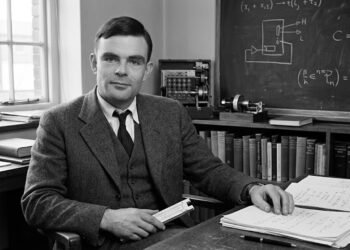



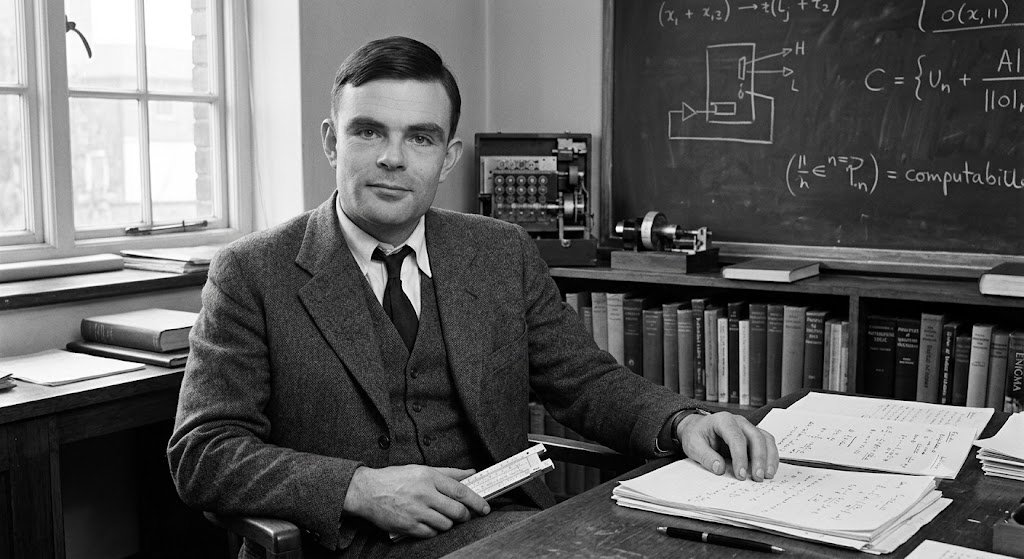
Alan Mathison Turing (1912–1954) stands as one of the most brilliant and influential figures of the 20th century. A genius mathematician, logician, cryptanalyst, and theoretical biologist, Turing laid the foundational blueprints for modern computer science, pioneered artificial intelligence, and played a pivotal role in saving millions of lives during World War II by cracking the German Enigma code.
Despite his monumental achievements, Turing’s life was marked by deep personal tragedy due to societal prejudice. Today, his work powers every smartphone, computer, and AI algorithm in existence.
1. Early Life and Education
Alan Turing was born on June 23, 1912, in Maida Vale, London. His father, Julius Mathison Turing, worked in the Indian Civil Service, while his mother, Ethel Sara Stoney, came from a family of engineers and scientists.
From an early age, Turing displayed signs of extraordinary intellectual capability. At the age of 13, he attended the prestigious Sherborne School in Dorset. His natural inclination toward mathematics and natural sciences often clashed with the school’s classic-heavy curriculum, but his genius was unmistakable.
Key Formative Influences
- Christopher Morcom: At Sherborne, Turing formed a profound intellectual and romantic bond with fellow student Christopher Morcom. Morcom’s sudden death in 1930 from bovine tuberculosis deeply affected Turing, fueling his passion to understand the nature of human consciousness and how the mind operates.
- Higher Education: In 1931, Turing entered King’s College, Cambridge, where he graduated with first-class honors in mathematics. By 1935, at just 23 years old, he was elected a Fellow of King’s College for his work on probability theory.
- Doctorate at Princeton: Turing moved to the United States in 1936 to work at Princeton University under logician Alonzo Church. He completed his Ph.D. in 1938, introducing the concept of ordinal logic and hypercomputation.
2. Theoretical Breakthroughs: The Turing Machine
In 1936, Turing published his landmark paper, “On Computable Numbers, with an Application to the Entscheidungsproblem.” In this work, he solved a fundamental question posed by mathematician David Hilbert regarding whether an automated procedure could determine the truth of any mathematical statement.
To address this, Turing proposed a theoretical device known today as the Universal Turing Machine.
How the Turing Machine Works
- Components: An infinite strip of tape divided into squares, a read/write head, an internal state register, and a set of instructions (an algorithm).
- Concept: The head reads symbols on the tape, changes its internal state, modifies symbols, and moves left or right based on its instruction set.
- Significance: The Universal Turing Machine proved that a single machine could execute any computable algorithm simply by reading instructions stored on tape. This concept laid the foundational blueprint for modern software and programmable computers.
3. World War II and Bletchley Park: Cracking the Enigma Code
Upon the outbreak of World War II in September 1939, Turing joined the Government Code and Cypher School (GC&CS) at Bletchley Park. His mission was to decipher the encrypted communications of the Axis powers, most notably the German Military’s Enigma machine.
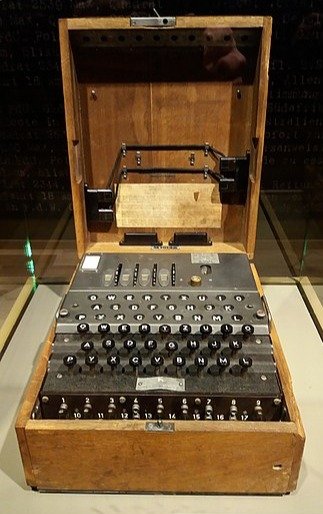
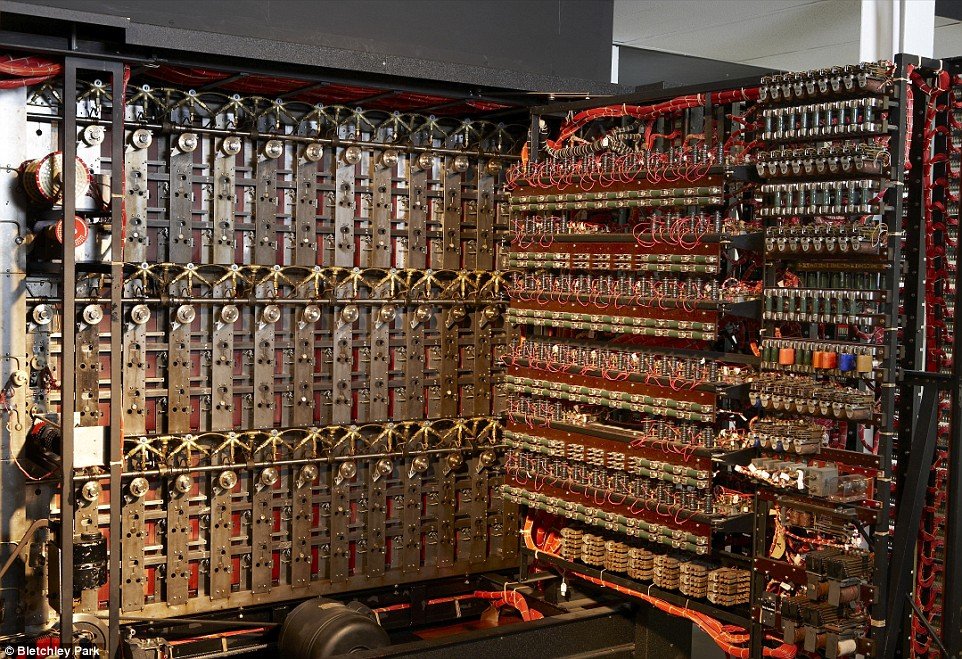
The Bombe Machine
German forces changed their Enigma machine settings daily, creating millions of possible key configurations. Building on earlier work by Polish mathematicians (such as Marian Rejewski), Turing designed the Bombe—an electromechanical machine capable of searching through thousands of potential Enigma rotor combinations in minutes.
Impact: The intelligence produced at Bletchley Park, codenamed Ultra, provided critical insights to Allied commanders. Historians estimate that Turing’s codebreaking efforts shortened the war in Europe by two to four years and saved over 14 million lives.
Hut 8 and Naval Enigma
Turing headed Hut 8, the section responsible for cracking German Naval Enigma communications. German U-boats were devastating Allied supply convoys in the Atlantic. Turing’s specialized statistical techniques (termed Banburismus) allowed the Allies to track U-boat positions, helping turn the tide in the Battle of the Atlantic.
Toward the end of the war, Turing also developed Delilah, an early portable system for encrypting voice communications.
4. Post-War Innovations: Building the Modern Computer and AI
After the war, Turing brought his theoretical ideas into reality, pioneering early physical computer hardware and foundational concepts in Artificial Intelligence.
The Automatic Computing Engine (ACE)
In 1945, Turing joined the National Physical Laboratory (NPL) in London, where he drafted the complete design for the Automatic Computing Engine (ACE). Unlike other early computer designs, Turing’s ACE incorporated stored-program concepts, high-speed memory, and subroutines.
Manchester Mark 1 and Early Programming
In 1948, Turing joined the Computing Machine Laboratory at the University of Manchester. He helped refine the software for the Manchester Mark 1, writing one of the earliest programming manuals in history.
The Turing Test (1950)
In his famous 1950 paper, “Computing Machinery and Intelligence”, Turing asked a fundamental question: “Can machines think?” To test machine intelligence, he introduced the Imitation Game, now known worldwide as the Turing Test.
- An evaluator engages in natural language conversations with a human and a machine.
- If the evaluator cannot reliably tell the machine apart from the human, the machine is said to demonstrate human-like intelligence.
5. Mathematical Biology: The Chemical Basis of Morphogenesis
In 1952, Turing pivoted to an entirely different scientific field: mathematical biology. He published “The Chemical Basis of Morphogenesis”, a paper exploring how non-uniform biological patterns—such as the stripes on a zebra, spots on a leopard, or spiraling petals on a sunflower—develop from uniform embryonic cells.
Turing introduced a set of reaction-diffusion equations, predicting that interacting chemical substances (morphogens) diffusing across a tissue could spontaneously create complex patterns. Decades later, biological experiments confirmed his mathematical theory.
6. Personal Life, Prosecution, and Tragic Death
Despite his extraordinary contributions to world war victory and science, Alan Turing’s life was tragically derailed by laws criminalizing homosexuality in 1950s Britain.
Arrest and Conviction (1952)
In early 1952, after a break-in at his home, Turing reported the incident to the police. During the investigation, he acknowledged a consensual relationship with a 19-year-old man, Arnold Murray. Under Section 11 of the Criminal Law Amendment Act 1885, Turing was charged with “gross indecency.”
To avoid imprisonment, Turing accepted chemical castration—a forced regimen of synthetic estrogen injections designed to suppress libido. As a result of his conviction:
- His security clearance was immediately revoked.
- He was barred from continuing his cryptologic work with GCHQ.
- He was subjected to government surveillance due to foreign policy fears regarding gay security risks during the Cold War.
Death (1954)
On June 8, 1954, Turing’s housekeeper found him dead at his home in Wilmslow. The official cause of death was ruled as cyanide poisoning, with a half-eaten apple found near his bed. An inquest determined that he had committed suicide on June 7, 1954, at the age of 41.
7. Legacy, Pardons, and Recognition
For decades, the full extent of Turing’s wartime contributions remained classified under the Official Secrets Act. Only in the late 20th and early 21st centuries did his full story emerge.
| Year | Milestone / Recognition |
|---|---|
| 1966 | The Association for Computing Machinery (ACM) establishes the Turing Award, widely considered the “Nobel Prize of Computer Science.” |
| 1999 | Time Magazine names Alan Turing one of the 100 Most Important People of the 20th Century. |
| 2009 | British Prime Minister Gordon Brown issues an official public apology on behalf of the government for the “appalling” treatment of Turing. |
| 2013 | Queen Elizabeth II grants Alan Turing a posthumous Royal Pardon. |
| 2017 | The UK passes “Turing’s Law,” granting posthumous pardons to thousands of men convicted under historical anti-homosexuality laws. |
| 2021 | The Bank of England officially releases the £50 polymer banknote featuring Alan Turing’s portrait and mathematical formulas. |
Alan Turing’s work redefined the boundaries of mathematics, computing, and biology. His vision laid the foundations of the modern digital age, and his legacy endures as a symbol of scientific genius and social justice.
Read more : https://yipzap.com/alan-turing-memes-that-explain-why-he-died-a-computing-legends-tragic-story/








1 Comment